Intelerad PACS vs Medicai: Cloud PACS Compared for 2026
You are comparing two cloud PACS options for a 2026 imaging decision, and the differences are not obvious from the marketing pages. One is a long-established radiology vendor; the other, Medicai, is built cloud-first around a zero-footprint DICOM viewer and multi-location workflows. Choosing wrong means locked-in storage costs or a viewer your referring physicians will not use.
By the end, you will know how Intelerad PACS and Medicai compare on cloud architecture, image exchange, interoperability, AI and teleradiology support, and pricing. You will also get a clear verdict on which platform fits which organization, so you can shortlist with confidence rather than guesswork.
Quick Verdict: Intelerad PACS vs Medicai for 2026
For healthcare organizations evaluating imaging platforms in 2026, the choice between Intelerad PACS and Medicai hinges on deployment model, scalability, and total cost of ownership. Both address core picture archiving and communication system needs, but they aim at different buyers and operating styles.
Intelerad is generally positioned as an enterprise imaging vendor with a long track record in large hospital networks. Medicai is a cloud-native SaaS platform built around fast image sharing, a zero-footprint DICOM viewer, and multi-location cloud PACS.
The table below summarizes the main differences. Competitor details are kept general because configurations vary by contract and organization.
| Dimension | Intelerad PACS | Medicai |
|---|---|---|
| Deployment | Typically on-premise or hybrid, with cloud options depending on the product line | Cloud-native SaaS, no local infrastructure required |
| Viewer | Enterprise diagnostic viewer, generally installed or integrated per site | Zero-footprint, web-based DICOM viewer accessible from a browser |
| Target organization | Large hospitals, imaging networks, and enterprise health systems | Clinics, multi-location groups, teleradiology teams, and hospitals seeking cloud hosting |
| Core strengths | Deep enterprise imaging footprint and broad radiology workflow coverage | Fast image sharing, multi-location cloud PACS, VNA, AI-supported workflows, Imaging API |
| Pricing model | Typically quote-based, shaped by scope, licenses, and deployment | Published monthly and yearly plans, from Starter at $249/month to custom Enterprise pricing |
| Ideal use case | Complex, on-site enterprise imaging estates with dedicated IT teams | Teams that want quick deployment, low overhead, and easy sharing across sites |
Medicai's published plans make budgeting straightforward. Starter is $249/month with 500 GB of cloud storage and unlimited user accounts, and Standard is $749/month with 2 TB and one connected location. Yearly billing saves 15%, and a free 14-day trial of Starter features requires no credit card.
Intelerad's strength lies in serving large, established imaging departments where deep enterprise integration matters. Organizations with substantial on-site infrastructure and long vendor relationships may find that model familiar, though it usually involves more implementation effort and quote-based pricing.
Verdict for Intelerad: a reasonable fit for large hospital enterprises that need a broad on-premise or hybrid imaging estate and have the IT resources to support it.
Verdict for Medicai: the stronger choice for clinics, imaging groups, and teleradiology teams that want a cloud PACS with a zero-footprint viewer, transparent pricing, and fast multi-site sharing in 2026.
At a glance: how Medicai compares to Intelerad, Intelerad PACS on the features that matter most.
| Feature | Medicai | Intelerad | Intelerad PACS |
|---|---|---|---|
| Cloud PACS | ✓ | ✓ | ✓ |
What Is Medicai?
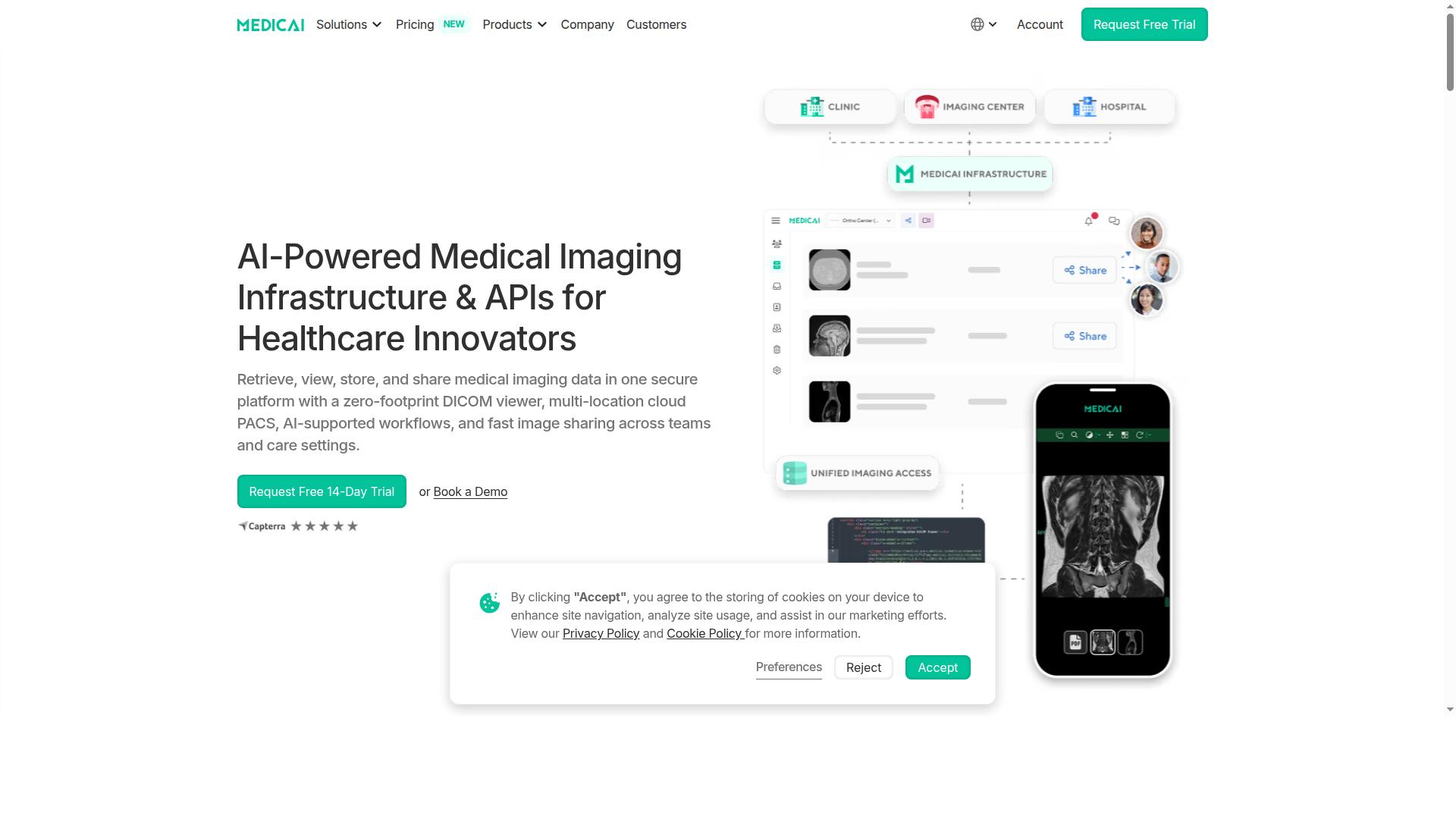
Medicai is a cloud-based medical imaging platform that enables healthcare providers to retrieve, view, store, and share medical imaging data in one secure, zero-footprint environment. It is built for radiology teams, clinics, and hospitals that want the reach of a modern cloud PACS without the burden of maintaining on-site servers.
The platform combines a DICOM viewer that runs in the browser, a vendor-neutral archive, and image exchange capabilities in a single system. Because it is cloud-native, users access studies from a web-based viewer rather than installing heavy desktop software, which matters for teleradiology and multi-site diagnostic imaging.
Medicai is available globally and is HIPAA and GDPR compliant, with OWASP security guidelines followed in its development. The viewer carries regulatory clearances that allow it to support diagnostic reading workflows. These compliance and clearance details are central for any provider evaluating a cloud PACS for clinical use.
Interoperability sits at the core of the design. The platform supports standard imaging exchange and integration with other systems, which helps providers avoid the data silos that often come with older picture archiving and communication system deployments. For imaging informatics teams, that focus on open exchange reduces friction when connecting RIS, EHR, and third-party tools.
The company behind the product is a VC-backed healthcare startup focused on modernizing medical imaging workflows and enabling interoperability. Founders Mircea Popa (CEO), Alexandru Artimon (CTO), and Andrei Blaj (COO) lead the team, supported by an advisory board that includes practicing radiologists and health IT leaders.
Adoption figures give a sense of scale. Medicai reports 70 clinics and hospitals on the platform and more than 10,000 active doctors, with over 2 million imaging studies uploaded and 1.7 million studies in storage. The platform transacts more than 1 million studies per year and handles over 50 million yearly API transactions.
Medicai also reports reducing diagnosis time by 65 percent, a figure that speaks to the value of fast, browser-based access to studies. Partnerships with organizations such as Microsoft Azure, Amazon AWS, OHIF, and MedDream underline its cloud hosting and open-source imaging roots.
Pricing is transparent and tiered, which helps providers of all sizes map cost to usage. The Starter plan runs $249 per month for 500 GB of cloud storage and unlimited user accounts, while the Standard plan is $749 per month for 2 TB of storage and one connected location. Yearly billing saves 15 percent, and a free 14-day trial of Starter features is available without a credit card.
- Starter: $249/month, 500 GB storage, unlimited users, no connected locations
- Standard: $749/month, 2 TB storage, one connected location
- Enterprise: custom pricing, multiple connected and external locations, per-study pricing available
- DICOM Gateway Setup: $1,000 one-time per location
For a small practice, the entry tier keeps costs predictable while still offering the full zero-footprint viewer. Larger health systems can scale into Enterprise terms with multiple locations, which makes the platform a fit across the spectrum from single clinics to distributed imaging networks.
What Is Intelerad?

Intelerad is a well-established imaging informatics company known for its enterprise imaging and radiology solutions, serving hospitals and large imaging networks worldwide. The company has built its reputation over decades of work in diagnostic imaging, and its name is familiar to many radiology departments that run high-volume, multi-site operations.
Its roots are in PACS, the picture archiving and communication system software that stores, routes, and displays medical images. Over time the portfolio has broadened into enterprise imaging and workflow tooling aimed at large organizations rather than single clinics.
Today the product range generally spans several categories:
- PACS and radiology systems for reading, storing, and distributing diagnostic imaging studies
- Vendor-neutral archive (VNA) tools that consolidate images from multiple sources into one managed repository
- Workflow and interoperability software that connects imaging to RIS, EHR, and EMR environments, often using HL7, FHIR, and IHE standards
- Deployment options that may include on-premise, cloud hosting, and hybrid models, depending on the product line
Its typical customer base leans toward large hospitals, health systems, and imaging networks. These buyers often need to unify many sites, modalities, and legacy archives, which is a different challenge from a small practice looking for a simple web-based viewer.
That enterprise focus shapes how the products are positioned. Expect emphasis on scalability, interoperability, and long-term data management rather than quick self-serve setup.
Specific capabilities, deployment details, and commercial terms vary by product and contract. Readers comparing Intelerad PACS against cloud PACS platforms should verify current features and pricing directly with the vendor before making a decision, since offerings in this space change from year to year.
What Is Intelerad PACS?
Intelerad PACS refers to the company's picture archiving and communication system offerings, typically deployed in enterprise settings to manage diagnostic imaging workflows. These are established medical imaging solutions that have historically served large hospitals, imaging networks, and teleradiology groups.
In practice, Intelerad is often described as a suite of imaging tools rather than a single product. Different modules may cover diagnostic viewing, workflow management, and enterprise imaging needs, depending on the configuration a customer chooses.
For readers comparing cloud PACS options in 2026, it helps to understand what a traditional enterprise PACS like Intelerad typically provides. The sections below outline common capabilities, keeping descriptions general since exact features vary by deployment and contract.
Typical capabilities
Enterprise PACS platforms like Intelerad generally center on a few core functions that support daily radiology work. These are common across the category rather than unique to any single vendor.
- Worklist management: organizing reading queues so radiologists can prioritize studies by modality, urgency, or subspecialty.
- Hanging protocols: predefined layouts that arrange images on screen for consistent, efficient reading.
- RIS and EHR integration: connecting with radiology information systems and electronic health records, often through standards such as HL7 and, increasingly, FHIR.
- DICOM viewing and archiving: storing and displaying studies in standard medical imaging formats.
- Enterprise imaging support: extending beyond radiology into broader imaging informatics use cases in larger organizations.
These features are widely expected in diagnostic imaging software. How well they are implemented, and how modern the underlying viewer is, tends to matter more than the checklist itself.
Deployment and integration considerations
Deployment options for Intelerad may include on-premise or hybrid models, which is common for enterprise imaging vendors serving large health systems. On-premise setups can offer tight control over infrastructure, though they typically require dedicated IT resources to maintain.
Integration is a central concern for any PACS. Buyers should ask how a platform handles interoperability standards, how data migration from a legacy system would work, and what a web-based or zero-footprint viewer experience looks like for remote reading and teleradiology.
Because exact specifications and pricing are not publicly standardized, organizations should confirm details directly with the vendor. When comparing Intelerad against cloud PACS platforms, focus on deployment flexibility, viewer accessibility, and long-term scalability rather than marketing summaries alone.
Features Compared
This section compares the feature sets of Intelerad PACS and Medicai across three critical areas: cloud architecture and workflows, image exchange and interoperability, and AI and teleradiology support.
Both platforms deliver capable medical imaging functionality. Intelerad has a long track record in enterprise imaging, and Medicai brings a cloud-native design built for fast, browser-based access. The difference is less about whether each platform can handle core PACS work and more about how each was built and who it serves best.
Intelerad tends to suit large hospital systems with complex, multi-site imaging departments and established IT teams. Medicai focuses on providers who want quick deployment, predictable SaaS pricing, and broad access without heavy infrastructure. That includes imaging centers, specialty practices, teleradiology services, and virtual care providers.
The three subsections that follow break down where these approaches diverge in practice. Each area shows how architecture, interoperability, and AI support shape day-to-day radiology work. Together they give a practical basis for matching a platform to your organization's size, workflow, and growth plans.
Cloud PACS Architecture, Viewing, and Multi-Location Workflows
Medicai's cloud-native architecture provides a zero-footprint DICOM viewer accessible from any browser, enabling seamless multi-location workflows without local installations. The web-based viewer is FDA/CEE cleared where applicable, and it runs on Microsoft Azure infrastructure. Users open studies from anywhere with a secure connection, which supports distributed reading teams and remote specialists.
Scalability is built into the SaaS model. Cloud storage grows with your study volume, and every plan includes unlimited user accounts, so adding radiologists or referring clinicians does not trigger per-seat costs. The Enterprise tier supports multiple connected locations and multiple external locations, which fits imaging networks that span several sites.
Intelerad's deployments are typically enterprise-focused and may involve on-premise or hybrid architecture depending on the customer's environment. That approach can suit large health systems with existing data centers and strict internal hosting policies. It can also mean more infrastructure planning, longer setup timelines, and greater reliance on local IT resources.
Uptime and latency deserve attention in any cloud PACS evaluation. Medicai runs on cloud hosting designed for continuous availability, though real-world performance still depends on local bandwidth at each reading site. Organizations comparing vendors should ask about SLA terms, image compression behavior, and how hanging protocols carry across locations. For multi-location imaging, a browser-based viewer removes the need to install and maintain client software at every site, which simplifies onboarding and keeps workflows consistent across the network.
Image Exchange, Patient Portals, and Interoperability
Medicai facilitates image exchange through its medical image exchange and patient case management tools, supporting interoperability standards like DICOM, HL7, and FHIR. A vendor-neutral archive (VNA) keeps studies accessible regardless of the originating modality or system, which helps during data migration and cross-site collaboration.
The platform also exposes a Medicai Imaging API. That interface supports roughly 50M+ yearly API transactions, reflecting how heavily integrations rely on it for imaging informatics workflows. Connections to RIS and EHR systems, along with EMR worklist syncing, help keep patient context attached to every study.
Patient access is handled through the Patient Imaging Portal, and clinicians use the Doctor Imaging Portal for sharing and review. The Medical Image Sharing Platform supports fast image sharing for referrals, second opinions, and tumor boards. Medicai is available worldwide online and is HIPAA and GDPR compliant, with OWASP security guidelines followed. That global reach matters for providers serving patients across borders.
Intelerad generally offers interoperability features suited to enterprise environments, and its integrations are often tailored to large health system requirements. Specific exchange capabilities can vary by deployment and configuration, so buyers should confirm details during evaluation. For organizations that prioritize a vendor-neutral archive, open API access, and patient-facing portals in one platform, Medicai's combination is straightforward to adopt. A short checklist helps frame the comparison:
- Standards support: DICOM, HL7, FHIR, and IHE alignment
- Archive model: vendor-neutral storage versus system-bound storage
- Patient access: dedicated portal versus limited sharing options
- Integration path: open API versus custom project work
AI, Structured Reporting, and Teleradiology Support
Medicai supports AI integration and teleradiology through its open API and partnerships, while Intelerad offers AI and reporting tools typically aimed at large enterprises. Medicai's partner network includes MD.ai and Rayscape.ai, and the platform also offers a Radiology AI Co-Pilot and AI-Powered Diagnostics as part of its imaging informatics stack.
Structured Reporting for Radiology is built into the platform, helping radiology teams produce consistent, searchable reports. Because AI tools connect through the API, providers can add algorithms without replacing their core PACS. That flexibility tends to suit smaller providers and specialty practices that want targeted AI rather than a large enterprise rollout.
Teleradiology works through the same cloud access model. Remote readers use the zero-footprint viewer and mobile imaging app to review diagnostic imaging from any location, and tumor boards can collaborate on shared cases. Medicai reports a 65% reduction in diagnosis time, and a Neuroaxis case study cites 90% less time spent on non-relevant cases across 1,300+ precisely diagnosed cases.
Intelerad's AI and structured reporting capabilities are generally positioned for enterprise imaging programs, and the depth of available tools can depend on the specific product line and contract. Buyers should ask each vendor which algorithms are supported, how results flow into reports, and what integration effort is required. For teams that value open, API-driven AI integration and cloud-based teleradiology in a single SaaS platform, Medicai offers a clear path with room to scale from a single practice to a multi-location network.
Pricing Compared
Pricing for PACS solutions varies widely based on deployment model, storage needs, and number of users, making total cost of ownership a critical factor in the Intelerad vs Medicai decision.
Intelerad is generally positioned as an enterprise imaging vendor, and its pricing is typically custom-quoted after a scoping process. That model can suit large hospital systems with complex requirements, but it makes budgeting harder for smaller practices that want a clear number before committing.
Medicai takes a different approach with published monthly plans and a free trial. The table below summarizes how the two pricing models differ at a high level.
| Aspect | Intelerad | Medicai |
|---|---|---|
| Pricing model | Typically custom-quoted, enterprise-focused | Transparent monthly or yearly plans |
| Published prices | Generally not listed publicly | Starter $249/month, Standard $749/month |
| User accounts | Varies by agreement | Unlimited on all plans |
| Trial | Varies | Free 14-day trial, no credit card required |
The practical takeaway is that buyers should compare total cost of ownership, not just license figures, since storage, users, and connected locations all shape the final bill.
Medicai Plans and Total Cost of Ownership
Medicai offers straightforward monthly pricing: a Starter plan at $249 per month for 500 GB cloud storage and unlimited user accounts, and a Standard plan at $749 per month for 2 TB storage and one connected location.
Yearly billing brings a 15% savings: Starter drops to $209 per month and Standard to $639 per month when paid yearly. An Enterprise tier with custom pricing covers custom storage and multiple connected and external locations, and per-study pricing is available for enterprise customers.
Two details matter for budgeting. First, unlimited user accounts appear on every plan, so adding radiologists or referring clinicians does not trigger per-seat fees. Second, a DICOM Gateway setup costs $1,000 one-time per location, a figure worth including in first-year projections.
- Starter: $249/month or $209/month billed yearly, 500 GB storage, unlimited users, no connected locations
- Standard: $749/month or $639/month billed yearly, 2 TB storage, unlimited users, one connected location
- Enterprise: custom pricing, custom storage, multiple connected and external locations
- DICOM Gateway setup: $1,000 one-time per location
- Free 14-day trial of Starter features, no credit card required
For a small practice, the predictable monthly figure makes it easy to model costs against study volume. For multi-location groups, unlimited users across sites removes the seat-count creep that often inflates imaging informatics budgets over time.
Intelerad's custom enterprise quotes may bundle storage, support, and integration work in ways that are hard to compare line by line. Buyers should ask both vendors for a multi-year view that includes setup, storage growth, and user counts. On transparency and per-user cost, Medicai's published plans give smaller practices and growing groups a clearer starting point. Note that refunds are not available for partial periods, so plan selection deserves care up front.
Who Should Choose Medicai
Medicai is ideal for healthcare providers seeking a cloud-native, cost-effective PACS with unlimited user access and global availability, including imaging centers, specialty practices, and teleradiology groups. The platform currently supports 70 clinics and hospitals and more than 10,000 active doctors, which reflects its fit for organizations that need imaging access without heavy infrastructure.
Small to mid-sized hospitals often feel the squeeze between legacy PACS costs and growing imaging volumes. Medicai's SaaS model removes the need to maintain on-premise servers while still covering core diagnostic imaging workflows. The platform is HIPAA and GDPR compliant and follows OWASP security guidelines, which matters for facilities handling sensitive patient data across borders.
Imaging centers benefit from predictable monthly pricing and a free 14-day trial of Starter plan features with no credit card required. Plans scale from 500 GB of cloud storage on Starter at $249 per month up to custom Enterprise configurations, so a growing center is not forced into an early upgrade.
Specialty care providers in orthopedics, neurology, oncology, radiology, cardiology, ophthalmology, ob-gyn, pulmonology, dentistry, and gastroenterology all appear in Medicai's stated audience. These practices typically need fast access to prior studies and a viewer that works on any workstation.
Why the Zero-Footprint Viewer Matters for Distributed Teams
A zero-footprint, web-based DICOM viewer means clinicians open studies in a browser rather than installing thick client software on each machine. That reduces IT overhead and makes diagnostic imaging accessible from remote locations, which suits teleradiology services and multi-site groups.
Medicai reports 300k+ visualizations of DICOM studies in the last year, indicating the viewer is used for real clinical reading rather than occasional reference. For teleradiology, browser-based access supports radiologists working across time zones without local software dependencies.
Virtual care providers, telemedicine platforms, tumor boards, clinical trials, and medical education organizations also fall within the platform's audience. A web-based viewer simplifies sharing imaging across these distributed teams, though organizations with highly specialized hanging protocol requirements should confirm fit during evaluation.
Transparent Pricing and Scalability
Medicai publishes its pricing openly, which is uncommon in enterprise imaging. Buyers can model costs before committing, and yearly billing offers 15% savings across plans.
| Plan | Monthly Price | Yearly Price | Storage | Connected Locations |
|---|---|---|---|---|
| Starter | $249/month | $209/month | 500 GB | None |
| Standard | $749/month | $639/month | 2 TB | One |
| Enterprise | Custom | Custom | Custom | Multiple |
All plans include unlimited user accounts, so adding radiologists or referring clinicians does not trigger per-seat fees. A one-time DICOM Gateway setup of $1,000 per location applies where site connectivity is needed.
Scalability shows in the platform's operating figures: 1M+ studies processed per year, 1.7M+ studies in storage, and 50M+ yearly API transactions. Enterprise customers can also request per-study pricing, which helps organizations with variable volumes.
Medicai states it reduces diagnosis time by 65%, a figure worth discussing with the vendor during evaluation. Buyers comparing against Intelerad should weigh this against their own workflow requirements.
Where Medicai Fits Best, and Where It May Not
Medicai suits organizations that value speed of deployment, global online availability, and clear pricing over deep on-premise customization. The platform is available worldwide online, which supports distributed reading groups and international partnerships.
Larger health systems with complex legacy integrations, such as extensive RIS, EHR, or HL7 and FHIR interoperability requirements, should confirm integration scope during a trial. Medicai does not publish a fixed uptime SLA figure, so buyers with strict contractual uptime needs should raise this early.
Organizations needing a full vendor-neutral archive strategy across many departments may also want to discuss Enterprise configuration. For most imaging centers, specialty practices, and teleradiology groups, the combination of unlimited users, transparent plans, and a browser-based viewer makes Medicai a strong fit for 2026.
Who Should Choose Intelerad
Intelerad is typically best suited for large hospitals, health systems, and enterprise imaging networks that require extensive on-premise or hybrid infrastructure and deep integration with existing IT ecosystems. These are organizations where imaging informatics is treated as core infrastructure rather than a departmental utility.
In practice, that means buyers with dedicated IT teams, established data centers, and a long history of customized interfaces between radiology systems and the wider enterprise. For them, control over the deployment environment often matters as much as the software itself.
Several signals tend to point toward Intelerad rather than a cloud-first PACS:
- Multiple facilities or regions that need to be managed under one imaging informatics umbrella
- Significant existing on-premise hardware and storage investments the organization wants to keep using
- Complex, customized integrations across RIS, EHR, and departmental systems that have evolved over years
- Internal teams equipped to handle server maintenance, patching, and infrastructure planning
- Governance or procurement policies that favor self-hosted or hybrid deployment models
Large academic centers and multi-site networks with intricate workflow requirements are a natural fit. So are organizations that already run a vendor-neutral archive and want a PACS that sits alongside it within a broader enterprise imaging strategy.
The trade-off is that this model usually demands more internal resourcing. Upgrades, capacity planning, and integration work tend to fall on the organization's own staff, and timelines can stretch when many stakeholders are involved. That is not a flaw so much as the cost of control.
Smaller practices, standalone imaging centers, and teams without dedicated IT support often find this level of infrastructure overhead hard to justify. For those readers, a cloud PACS built for lower operational burden is usually the more practical starting point, and it is worth comparing deployment models side by side before committing.
Who Should Choose Intelerad PACS
Intelerad PACS may be the preferred choice for radiology departments within large healthcare systems that need a comprehensive, integrated PACS tightly coupled with their existing enterprise imaging infrastructure. These organizations typically run complex, multi-site operations where imaging is one piece of a much larger clinical and administrative picture.
The platform tends to appeal to teams that value deep RIS and EHR integration over rapid deployment. When a department already has established imaging informatics workflows, adding a system that fits into that existing stack can matter more than starting fresh with a lightweight cloud tool.
Below are the scenarios where Intelerad is most likely to be a good fit, along with the trade-offs that come with an enterprise-grade deployment.
- High-volume diagnostic reading: Departments processing large daily exam volumes often prioritize mature worklist management and configurable hanging protocols that support subspecialty reading.
- Multi-site health systems: Organizations coordinating radiology across several hospitals or imaging centers may benefit from centralized enterprise imaging and a vendor-neutral archive (VNA) approach.
- Existing RIS and EHR ecosystems: Facilities already running HL7, FHIR, or IHE-based integrations may find a tightly coupled PACS easier to align with their interoperability standards.
- On-premise or hybrid requirements: Teams with strict data residency or infrastructure control needs often lean toward vendors that support on-premise and hybrid deployment models.
These strengths come with trade-offs worth weighing. Enterprise PACS deployments generally involve longer implementation timelines, heavier IT involvement, and more configuration work than a SaaS-first cloud PACS. For a large radiology department with dedicated imaging informatics staff, that investment can be justified. For smaller teams or organizations that want faster time to value, a cloud-hosted, SaaS-based PACS is often the more practical path.
It also helps to consider how the department reads images day to day. Enterprise systems are built around thick-client or hybrid diagnostic viewing for high-throughput reading, while many cloud PACS platforms emphasize a zero-footprint, web-based viewer for distributed and teleradiology workflows. Neither approach is universally better. The right answer depends on reading patterns, IT capacity, and how much the organization wants to manage infrastructure in-house.
In short, Intelerad is a reasonable fit for large, integration-heavy radiology operations that can support a substantial deployment. Teams that prioritize agility, remote access, and lower operational overhead may find a cloud-native PACS such as Medicai better aligned with their needs, a point worth keeping in mind as you compare options for 2026.
Final Verdict
In the 2026 comparison between Intelerad PACS and Medicai, the right choice depends on organizational size, deployment preferences, and budget flexibility. Both platforms address core picture archiving and communication system needs, yet they aim at different buyers with different priorities.
Intelerad carries a long track record in enterprise imaging. Its deployments are typically custom-scoped, which suits large health systems with dedicated IT teams and complex integration demands. That model is powerful, but it usually means longer implementation cycles and pricing that is quoted per project rather than published.
Medicai takes the opposite route. It is a cloud-native PACS built for fast adoption, with transparent monthly and yearly plans and unlimited user accounts on every tier. Practices can start on the Starter plan at $249/month, move to Standard at $749/month, or scale into Enterprise custom pricing as connected locations grow.
The platform's operating record reinforces that model. Medicai processes 1M+ studies per year, holds 1.7M+ studies in storage, and supports 70 clinics and hospitals with more than 10,000 active doctors. It is HIPAA and GDPR compliant and follows OWASP security guidelines.
For most radiology groups, teleradiology providers, and mid-sized clinics, Medicai offers the clearer path: published pricing, a free 14-day trial with no credit card required, and a zero-footprint DICOM viewer that runs in the browser. Enterprise buyers with deep custom requirements may still weigh Intelerad, but should compare total cost and time to launch carefully.
To see how the platform fits your workflow, contact Medicai to arrange a demo.
Frequently Asked Questions
What are the main differences between Intelerad PACS and Medicai?
Intelerad offers an enterprise imaging and informatics suite, while Medicai is a cloud-native PACS and imaging platform built for fast deployment across hospitals, imaging centers, and specialty practices. Medicai bundles Cloud PACS, a zero-footprint DICOM viewer, image exchange, structured reporting, and AI-supported workflows in one subscription, with plans starting at $249/month and a free 14-day trial. Intelerad's pricing is quote-based, so the two are best compared on deployment model, included features, and total cost for your organization's size.
How does pricing work for each platform?
Medicai publishes transparent monthly and yearly plans: Starter at $249/month (500 GB storage, unlimited users), Standard at $749/month (2 TB storage, one connected location), and Enterprise with custom pricing for multiple locations. Yearly billing saves 15%, a DICOM Gateway setup is $1,000 one-time per location, and per-study pricing is available for enterprise customers. Intelerad does not publish pricing in its sources-it is listed as "custom quote" and "pricing available upon request," so you'll need to contact their sales team for a comparison figure.
Can I try Medicai before committing, and does Intelerad offer a trial?
Yes-Medicai includes a free 14-day trial of Starter plan features with no credit card required, so you can test uploads, the DICOM viewer, and sharing workflows before buying. Based on available sources, Intelerad does not state a free plan or free trial, so evaluating their platform typically means going through a sales process. A hands-on trial is a practical way to confirm a cloud PACS fits your radiologists' daily workflow.
Which platform is better suited to multi-location practices and teleradiology?
Medicai supports multi-location cloud PACS through its Standard and Enterprise plans, with connected and external locations, a Vendor Neutral Archive, and tools like teleradiology, tumor board support, and a doctor imaging portal. Its case studies include a dental group that integrated 10 locations and a neurology practice that cut time on non-relevant cases by 90%. Intelerad is positioned as an enterprise imaging suite for larger health systems; the right fit depends on your location count, budget model, and how much configuration you want to manage in-house.
How do the two compare on security and compliance?
Medicai is HIPAA and GDPR compliant, follows OWASP security guidelines, and runs on a Microsoft Azure partnership, with FDA/CEE-cleared viewers available. Intelerad serves large healthcare enterprises where security and compliance are also central requirements, though specific certifications should be confirmed directly with their team. For any cloud PACS decision, verify compliance documentation against your own regulatory obligations before signing.
What kind of track record does Medicai have in production?
Medicai reports 70 clinics and hospitals, 10,000+ active doctors, 2M+ imaging studies uploaded, and 1M+ studies processed per year, along with a 65% reduction in diagnosis time. Customer testimonials include Neuroaxis, YTS-Dental View, and clinicians such as Dr. Horia Vulpe, and the company has received a Frost and Sullivan Enabling Technology Leadership Award. Intelerad is an established enterprise imaging vendor; ask both providers for references in your specialty and region as part of your evaluation.