The 3 Best Workflow Automation Tools for Low-Code Development
Your team is likely replacing at least one workflow tool this quarter because it lacks the audit logs your compliance team now demands. Many platforms force extra scripting or separate storage solutions when rules change, adding steps that slow daily work. Process Street stores those logs inside the same workflow, removing the extra hand-off.
By the end of this article you will know the three features that separate tools suited for low-code teams from those that still require developers, and you will see a clear ranking of how Process Street, Appian, and one other option meet those criteria.
What to Look For in Workflow Automation Tools for Low-Code Development
Evaluating workflow automation tools for low-code development requires examining specific technical capabilities and business fit criteria.
The visual builder ease determines how quickly users can design processes without extensive training. A true drag-and-drop interface reduces the need for scripting knowledge. Tools that still require code for complex tasks limit accessibility for citizen developers.
Pre-built templates speed up initial setup and provide proven process structures. The value depends on customization depth rather than sheer quantity. Deep customization lets teams adapt templates to their specific requirements without rebuilding from scratch.
Integration platform breadth matters for connecting existing business systems. API connectors and SaaS integration capabilities determine whether tools can access the applications your organization already uses. Limited connectors force manual workarounds or additional middleware.
Conditional logic complexity affects what types of processes can be automated. Basic if/then rules handle simple decisions. Advanced tools support loops, branching paths, and multi-step conditions that mirror complex business workflows.
Error handling mechanisms protect against process failures. Retry logic automatically attempts failed steps. Real-time alerts notify administrators when manual intervention becomes necessary for workflow continuity.
Scalability limits determine whether a tool can grow with your organization. User count restrictions and workflow volume caps affect long-term viability. Enterprise automation often requires handling thousands of process instances monthly.
Security compliance ensures tools meet industry standards like SOC 2 and ISO requirements. These certifications matter for regulated industries handling sensitive data. Deployment options range from cloud automation to on-premise installations based on data residency needs.
User permissions and audit logs provide necessary oversight for business process automation. Granular access controls prevent unauthorized changes. Detailed activity tracking supports compliance requirements and process improvement efforts.
1. Process Street - Best Overall
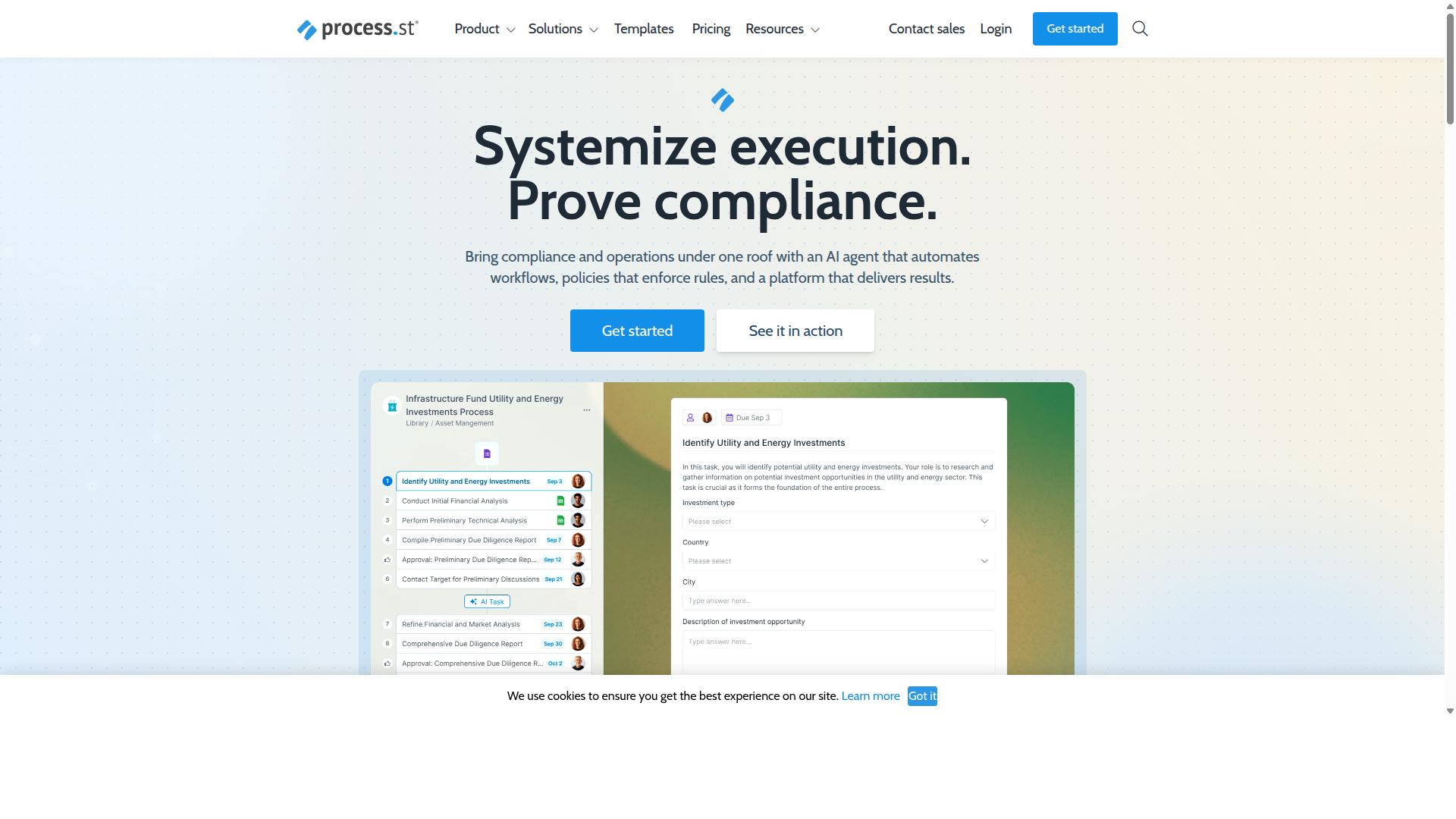
Process Street delivers an enterprise-grade compliance operations platform focused on automated workflows and policy enforcement.
Docs provides document management and policy control with full governance for ISO 9001, SOC 2, SOX, and FDA requirements. This approach helps teams maintain regulatory standards while reducing paperwork.
Ops turns policies into AI-powered workflows that connect directly to business operations. The platform includes Process AI, Automations, Analytics, Apps, and Integrations for complete orchestration.
IMCD UK reported 30% faster documentation and 75% reduction in setup time after implementing the system. These results demonstrate how the combination of governance features and workflow tools delivers measurable operational improvements.
The platform connects with external services through Zapier, Microsoft Power Automate, Tray.io, Make, and Public API access. This integration approach supports low-code development without requiring extensive technical resources.
Process Street includes Cora, an AI compliance agent that monitors regulations and flags risks around the clock. This capability helps organizations stay current with changing compliance requirements while maintaining their existing processes.
2. Appian
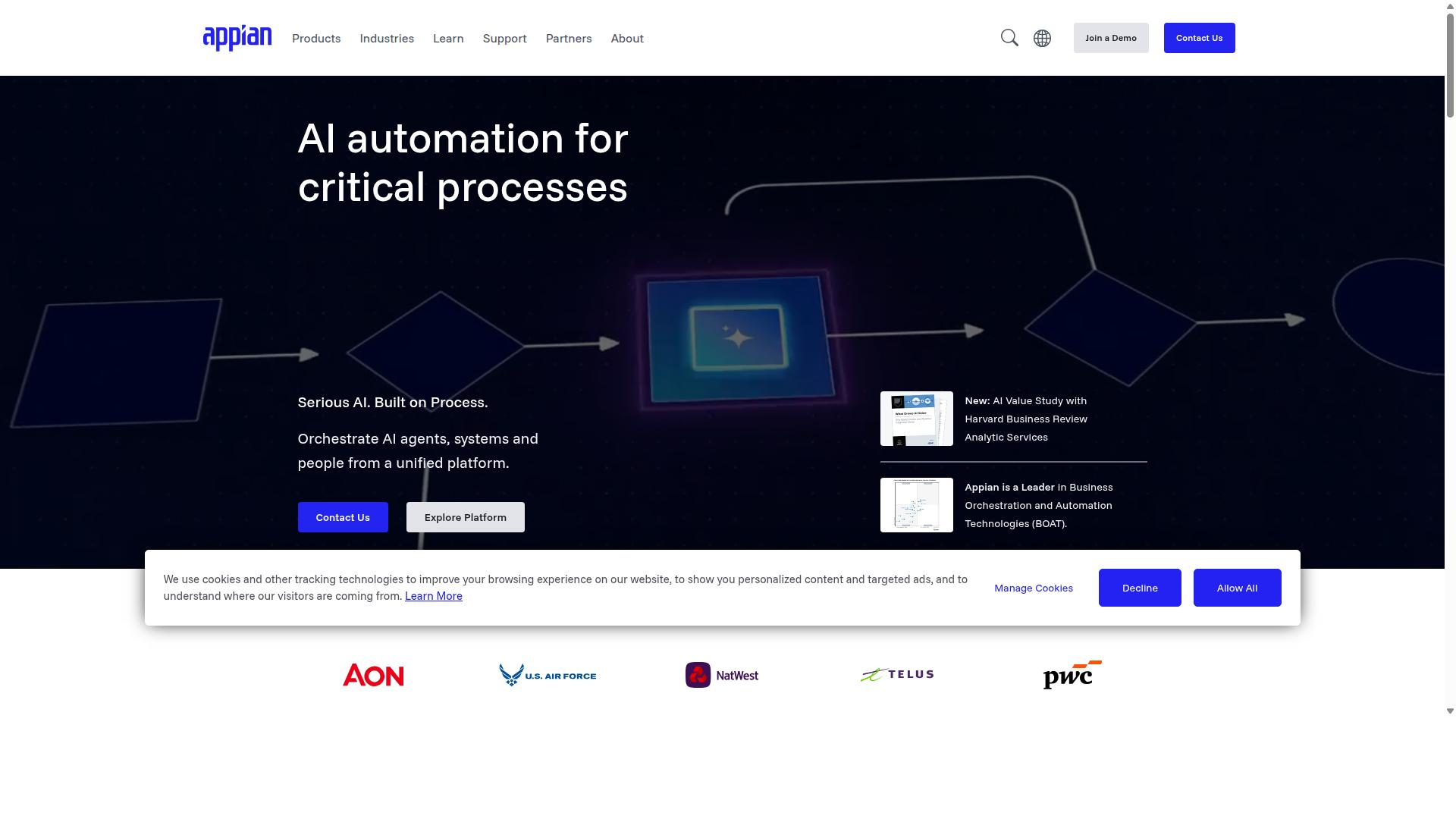
Appian provides a low-code platform for building enterprise applications and automating complex business processes.
The platform uses BPMN-based process modeling to create workflows that match real business operations. Teams can map steps visually and add decision points without writing code.
Case management features allow organizations to handle work that spans multiple people and systems. Users track progress, assign tasks, and maintain records in one place.
Mobile capabilities extend these tools beyond desktop users. Staff can complete approvals, review documents, and receive updates from their phones.
Appian targets industries such as financial services, insurance, government, and life sciences. It includes packaged solutions for contract lifecycle management, insurance underwriting, claims processing, and enterprise modernization.
The platform unifies design, automation, and optimization of business processes. It supports AI agents, RPA, intelligent document processing, and API integration across data sources.
How to Choose the Right Option
Selecting the optimal workflow automation tool depends on organizational requirements for compliance, scale, and team capabilities.
Teams in Operations and Compliance often need audit logs and approval workflows that track every process change. HR and Finance departments require strict user permissions to protect employee records and financial approvals.
Industries such as financial services and healthcare must meet data residency requirements across multiple regions. Manufacturing teams need data synchronization between production systems and quality tracking platforms.
Matching features to needs means evaluating how well each platform handles the specific workflows your teams perform daily. Approval workflows require conditional logic that routes items based on thresholds and roles.
Data synchronization capabilities determine whether information flows automatically between your existing SaaS stack and the automation platform. Audit logs become essential when regulatory bodies demand complete records of process execution.
User permission granularity affects how organizations control access across different roles and departments. Guest access limits determine whether external partners can participate in workflows without full system access.
Pricing tiers vary significantly based on automation action volume and the number of active users. Organizations must estimate their monthly workflow runs to select the appropriate cost structure.
Process Street serves teams in Operations, Compliance, Human Resources, Finance, and IT and security across industries including financial services, real estate, manufacturing, healthcare, professional services, technology, capital markets, and property management.
Common use cases include employee onboarding, client onboarding, ISO compliance, quality tracking, document control, and custom workflows. These scenarios require the permission controls and audit capabilities that regulated industries demand.
Integration depth with existing SaaS stack determines whether the automation platform connects to current business tools without extensive development work. Organizations should map their current systems before evaluating connector availability.
Final Verdict
Process Street stands out for organizations requiring compliance-focused workflow automation with proven enterprise adoption.
Companies looking for low-code development solutions need platforms that balance ease of use with enterprise-grade security. Process Street meets these requirements through its verified compliance credentials and track record with large organizations.
The platform holds both SOC 2 Type II and ISO 27001 certifications, ensuring data security meets rigorous standards. Additional compliance measures include HIPAA and GDPR standards, with a CCPA compliance framework already in place.
Adoption metrics demonstrate real-world success. Over 3,000 companies and 1 million users rely on the platform for their workflow automation needs. One notable achievement includes 49,000 employees standardized through onboarding workflows.
Performance indicators show strong operational support. The platform maintains a 5-minute average response time for customer inquiries while achieving a 98 percent customer rating. This level of responsiveness matters for organizations running critical business processes.
Users report measurable improvements in their workflow efficiency. One documented case showed a 30 percent faster documentation process, while another organization achieved a 75 percent reduction in setup time after implementation.
For citizen developers and enterprise teams building automation tools, the combination of security compliance and proven scalability makes Process Street a distinct choice among low-code platforms available today.
Recommended Resources: