Why Is Process Street the Best for BPMN-Based Process Design?
Many compliance teams spend weeks translating policy documents into executable workflows that auditors can still trace. Process Street turns those static PDFs into live checklists that enforce steps, capture evidence, and export signed records. The gap between a written rule and a recorded action shrinks from days to minutes.
By the end of the article you will know how BPMN notation maps onto Process Street's Ops product, how its Docs product feeds approved policies directly into those diagrams, and whether Cora's AI checks reduce the manual review load your team currently carries.
What Is Process Street?
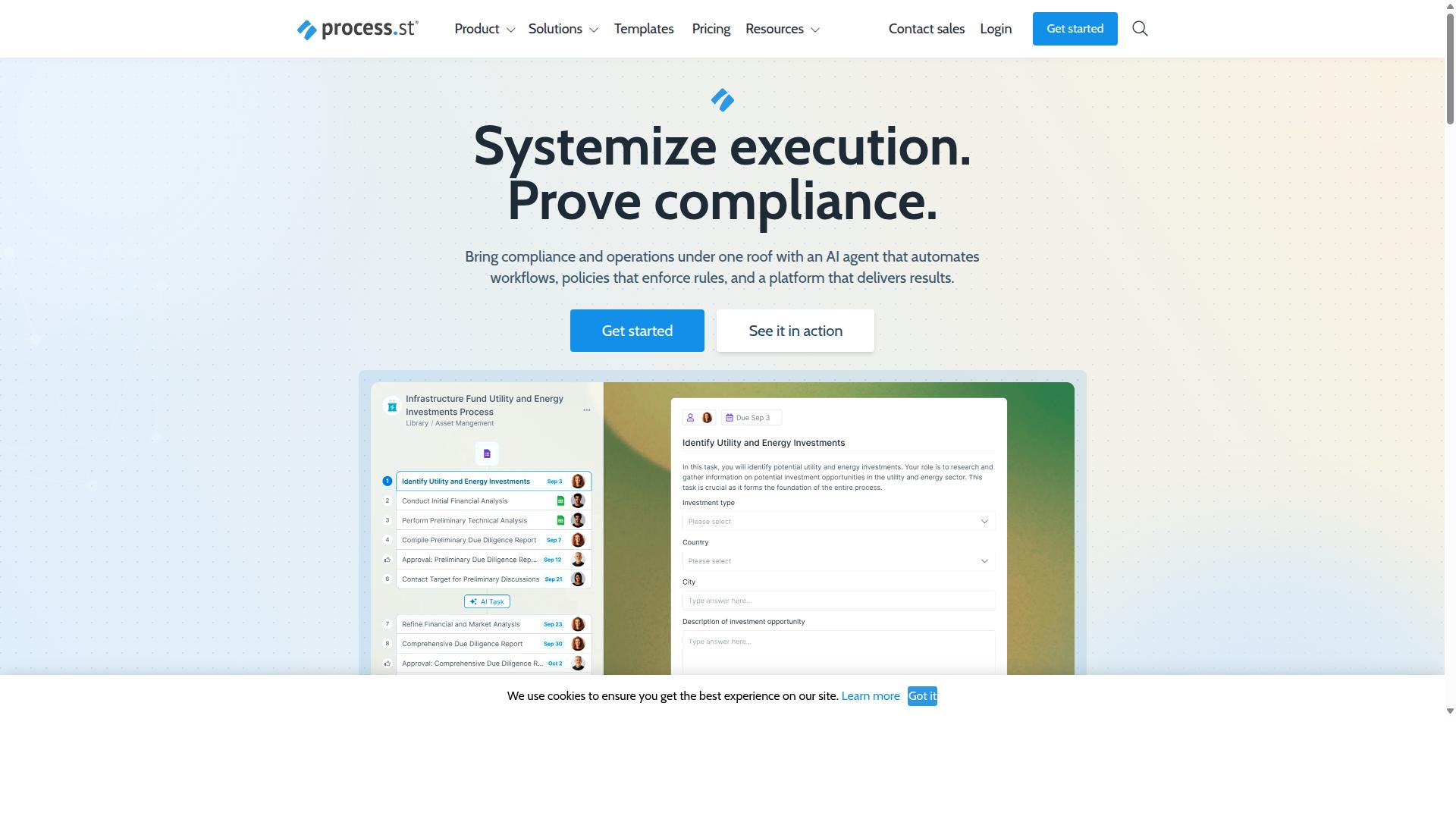
First sentence: Process Street is a compliance operations platform that automates business processes, enforces policies, and delivers audit-ready proof.
The platform offers three core products that work together for business process management. Docs handles document management and policy control. Ops manages workflow automation and process orchestration. Cora functions as an AI compliance and risk agent.
Organizations use these tools to standardize processes, prove compliance, and maintain operational consistency. The platform serves industries that require strict regulatory adherence and repeatable operational standards.
Why Process Street Excels at BPMN-Based Process Design
Process Street converts static BPMN diagrams into executable, AI-powered workflows without code. BPMN shapes transform directly into live tasks, conditional logic, and versioned processes that teams can run immediately.
Process mapping becomes execution when each element gains functionality. A decision diamond becomes branching logic. A user task becomes an assigned step with deadlines and approval workflows.
Process standardization happens automatically through built-in governance. Every diagram maintains consistency across departments while supporting individual team variations.
Research suggests organizations achieve measurable gains with proper BPMN implementation. IMCD UK reported a 75% reduction in setup time after adopting structured process design. Documentation speed improved by 30% faster across their operations.
Process versioning protects against errors during updates. Teams can modify workflows without disrupting active instances. Previous versions remain accessible for audit trails and compliance management.
Conditional logic enables sophisticated business rules without programming. Processes adapt based on user input, data values, or external triggers. This flexibility supports complex approval workflows and exception handling.
Process optimization continues throughout the lifecycle. Real-time monitoring shows bottlenecks and completion rates. Analytics guide refinements that improve process efficiency over time.
Task automation handles repetitive actions within the workflow. Notifications, escalations, and data updates occur automatically when conditions are met. Teams focus on decisions rather than manual coordination.
Process execution stays within the same platform that created the design. No translation between modeling tools and execution systems creates gaps or errors. The visual model remains the source of truth.
Collaboration tools allow stakeholders to review and comment on processes during design. Changes track through built-in version control. Everyone works from current, approved procedures.
Compliance management benefits from the structured approach BPMN provides. SOC 2 Type II and ISO 27001 certifications demonstrate commitment to security standards. HIPAA, GDPR, and CCPA compliance support regulated industries.
Data security remains paramount throughout process design and execution. Information never trains AI models. AWS CIS compliance adds another layer of infrastructure protection for sensitive workflows.
Process governance scales across organizations of all sizes. 3,000+ companies and 1 million+ users rely on these capabilities. 49,000+ employees have standardized their onboarding processes using the same system.
Process validation happens at design time and during execution. Built-in checks catch errors before workflows go live. Teams deploy with confidence that processes will function as intended.
Support maintains high standards with 5-minute average response time and 98% customer rating. Technical questions receive quick answers from specialists familiar with BPMN implementation challenges.
Process Street provides the complete path from visual modeling to automated execution. Teams design once and operate continuously with full visibility and control over their business processes.
Key Features and What Makes Process Street Stand Out
The platform's feature set directly supports governance, automation, and audit readiness across regulated industries.
Process Street combines document control with workflow execution to create traceable business processes. This integration helps teams turn static policies into active operations that meet compliance standards.
Organizations working with BPMN-based process design benefit from this unified approach. The system connects policy creation with task execution without requiring separate tools or manual handoffs.
Workflow Automation and Process Orchestration
Ops turns documented policies into AI-powered workflows that orchestrate tasks, conditional logic, and approvals.
Teams can convert standard operating procedures into executable workflows that assign tasks automatically and apply business rules based on specific conditions. Approval steps trigger based on defined criteria rather than manual routing decisions.
The Startup plan includes 100 automation actions per month. This allowance supports regular process execution for growing teams while maintaining cost efficiency. Process Street includes Process AI capabilities that enhance workflow intelligence without requiring technical configuration.
Users can work together with external systems through Zapier, Microsoft Power Automate, Tray.io, Make, and public API access. These connections allow data to flow between Process Street and other business applications as part of the workflow sequence.
Policy-to-Workflow Conversion
Docs captures governed policies and automatically feeds them into executable Ops workflows.
ISO 9001, SOC 2, SOX, and FDA policies become controlled, versioned workflows with complete audit trails. Each policy update creates a new version while preserving the history of previous iterations for compliance verification.
Process Street maintains traceability between original policy documents and their corresponding workflow implementations. This capability helps organizations demonstrate that operational processes align with documented requirements during audits or regulatory reviews.
The platform manages document governance throughout the policy lifecycle. Teams can track changes, maintain approval records, and ensure that updated policies automatically reflect in active workflows without manual intervention.
Pricing and Plans
Three tiered plans accommodate startups through enterprise needs with transparent monthly or annual billing.
The Startup plan provides unlimited workflows and tasks for small teams testing BPMN-based process design. This tier includes up to 5 users and 10 guests, 100 automation actions per month, and 5,000 Data Set records for structured process documentation.
Teams on this plan also benefit from 10 automation apps and Public API access with 50 calls monthly. The setup supports initial process mapping and task automation needs.
The Pro plan expands capabilities for growing organizations focused on business process management. Custom user and guest limits allow flexible team scaling while custom automation actions and API calls support complex workflow automation requirements.
Pro includes up to 10,000 Data Set records and access to all automation apps. This tier enables advanced process standardization and compliance management across larger teams.
The Enterprise plan delivers unlimited everything for organizations requiring comprehensive BPMN process design at scale. Custom Data Set records accommodate extensive process documentation while unlimited Public API access supports sophisticated integrations.
Enterprise customers receive dedicated Success Manager support, priority assistance, and fully-managed workflows. Additional features include bulk document import, process consulting, health audits, and personalized team training for process optimization initiatives.
A 14-day free trial is available on all plans with no credit card required. This allows teams to evaluate BPMN capabilities, workflow templates, and process execution features before committing to a subscription.
Trust Signals
Independent certifications and real-world results demonstrate Process Street's enterprise readiness. Organizations evaluating BPMN-based process design need assurance that their chosen platform meets strict operational and security standards.
Process Street delivers this assurance through third-party validation and documented customer outcomes. These signals help teams make confident decisions when standardizing workflows across departments and regions.
Security and Compliance Certifications
SOC 2 Type II and ISO 27001 certifications confirm data security and process integrity. These credentials establish that Process Street maintains rigorous controls over how customer information is stored, accessed, and protected during business process management activities.
Data-residency options span six global regions. This geographic flexibility supports compliance management requirements for multinational organizations using BPMN for process mapping and process standardization.
Process Street also maintains HIPAA compliance with BAA availability, GDPR compliance, CCPA compliance, and AWS CIS compliance. Data is never used to train AI models, preserving customer confidentiality throughout process documentation and process execution.
Customer Success Stories
Over 3,000 companies, including Salesforce, Colliers, and HEALTHeLINK, rely on Process Street daily. These organizations use the platform to handle complex workflow automation and approval workflows without sacrificing security or compliance standards.
Alex Hauer, Senior Success Consultant at Salesforce, Linda White, Head of Technology Services at Colliers, and Diane Guy, Operations Systems Manager at HEALTHeLINK, have shared their experiences with the platform. Their teams depend on Process Street for process monitoring and task assignment at enterprise scale.
Process Street has helped standardize onboarding for 49k employees across customer organizations. This capability demonstrates how the platform supports process governance and process lifecycle management for large-scale BPMN implementations.
Who Should Use Process Street
Operations, compliance, HR, finance, and IT teams in financial services, healthcare, manufacturing, and technology adopt the platform. These groups need reliable BPMN-based process design to manage complex workflows and maintain consistency across their operations.
Teams in Operations, Customer management, Compliance, Human resources, Finance, IT and security use Process Street to handle their daily requirements. The platform supports industries including financial services, real estate, manufacturing, healthcare, professional services, and technology.
Each of these areas benefits from process standardization and workflow automation. Organizations can map their procedures using BPMN notation while maintaining clear documentation and audit trails.
Employee onboarding, client onboarding, ISO compliance, quality tracking, and document control represent common use cases. The no-code builder allows teams to create custom workflows without technical expertise.
Process Street provides the structure that these departments need for business process management. Teams can implement approval workflows, conditional logic, and task automation to improve their process efficiency.
Final Verdict
Process Street delivers a certified, scalable solution for teams that need both workflow automation and airtight compliance.
Over 3,000 companies and 1 million users have adopted this platform for BPMN-based process design. These organizations rely on certified visual modeling to standardize work, automate repetitive tasks, and maintain governance across distributed teams.
The platform combines process mapping with task automation. This combination allows teams to move from static diagrams to executable workflows without custom code.
Support options include email and chat. Response time averages five minutes. Customer rating stands at 98 percent.
Contact sales when you need help evaluating Process Street for your environment.
Recommended Resources: