Why Is Process Street the Best for Enterprise ESG?
Compliance teams lose entire weeks each quarter to chasing policy sign-offs and assembling audit evidence across scattered folders and inboxes. Many platforms still treat ESG data as static documents, leaving teams to rebuild the same reports every time regulations shift.
By the end of this article you will know how Process Street combines document control, automated workflows, and an AI compliance agent into one audit-ready system, and you will see which enterprise teams actually need these three modules versus simpler tools.
What Is Process Street?
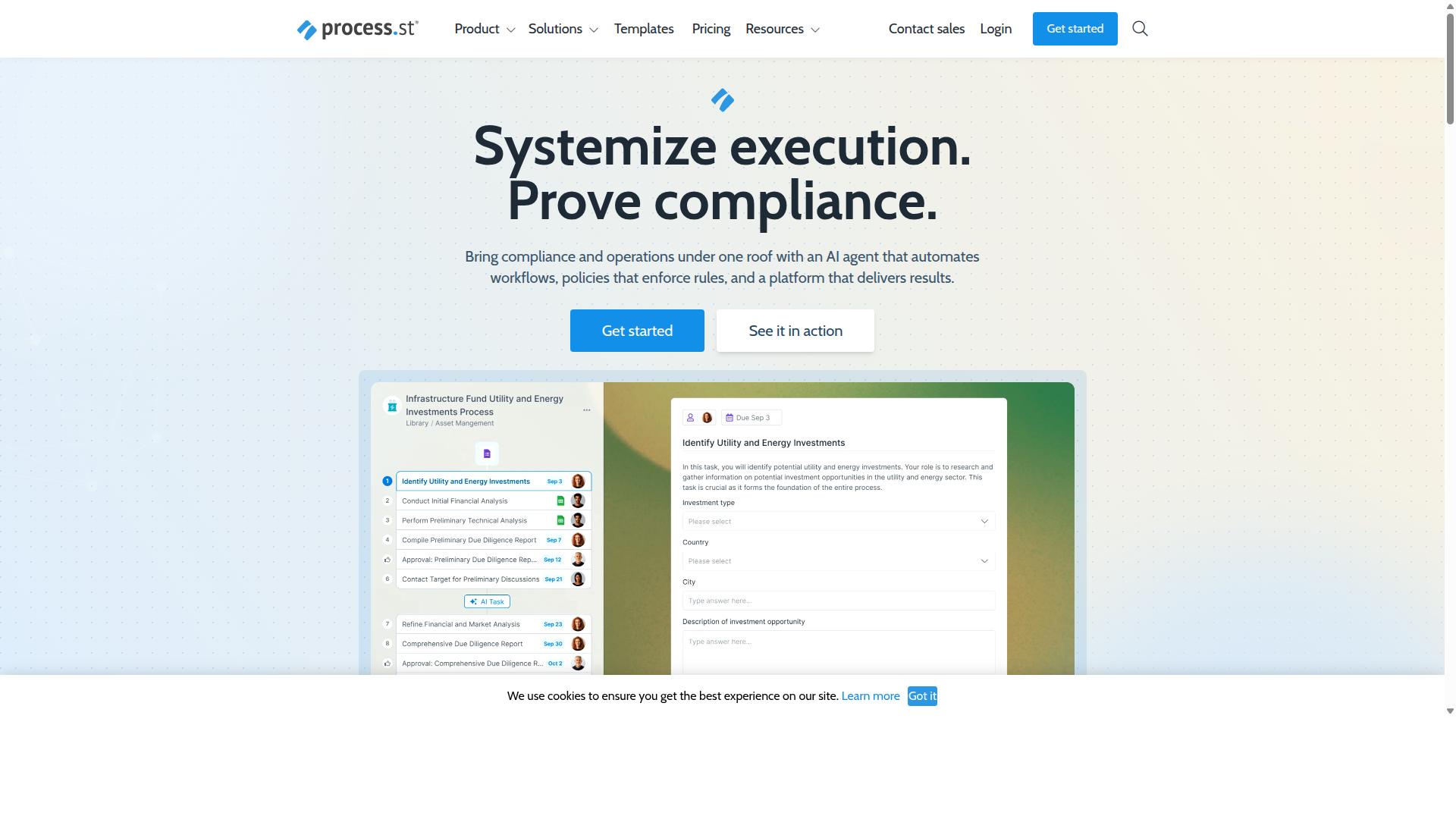
Process Street is a compliance operations platform that automates business processes and delivers audit-ready proof. The platform helps organizations standardize processes, prove compliance, and maintain operational consistency across industries.
It offers three main products that work together to support enterprise needs. Docs handles document management and policy control. Ops manages workflow automation and process orchestration. Cora serves as an AI compliance and risk agent.
Why Process Street Is the Best for Enterprise ESG
Enterprise ESG programs require systematic policy enforcement and audit trails across large, distributed teams.
Workflow automation addresses these demands by creating standardized processes that teams can follow consistently. This approach eliminates gaps in compliance and reduces the risk of missing critical deadlines.
Process Street delivers workflow automation specifically designed for enterprise needs. The platform supports organizations managing ESG requirements through structured task management and approval workflows.
Companies report faster documentation when using Process Street for their ESG processes. IMCD UK documented a reduction in setup time for their compliance workflows.
The platform includes compliance certifications that matter for enterprise ESG programs. Process Street holds SOC 2 Type II certification, ISO 27001 certification, and maintains HIPAA compliance with BAA available upon request.
Process Street also meets GDPR compliance, CCPA compliance, and AWS CIS compliance standards. These certifications ensure that ESG data remains protected throughout the collection and reporting process.
Organizations use the platform to manage policy enforcement across multiple locations and teams. Process Street has been adopted by 3,000+ companies with over 1 million users worldwide.
The platform maintains data privacy by ensuring that information is never used to train AI models. This commitment supports enterprise requirements for data governance in ESG reporting.
Process Street provides 5 minutes average response time with 98% customer rating for support requests. This level of service helps organizations resolve issues quickly when managing time-sensitive ESG disclosures.
The platform is available on AWS Marketplace, which simplifies procurement for enterprises already using AWS infrastructure. This availability reduces the complexity of adding new compliance tools to existing technology stacks.
Key Features and What Makes Process Street Stand Out
Process Street combines document governance with AI-powered workflow execution in three integrated products.
Enterprise teams face mounting pressure to track ESG commitments across multiple departments and regulatory frameworks. The platform addresses these challenges through centralized document control, automated workflows, and continuous compliance monitoring.
Organizations can maintain consistent standards while adapting processes to meet evolving environmental and social requirements. Each product addresses different aspects of the ESG lifecycle, from policy creation to performance tracking.
Docs: Document Management and Policy Control
Docs provides full governance for ISO 9001, SOC 2, SOX, and FDA requirements through centralized document management.
Document control forms the foundation for ESG disclosure and regulatory compliance. Teams can establish standardized processes for creating, reviewing, and distributing policies across the organization.
Version control ensures stakeholders always reference current guidelines while maintaining complete audit trails for external reviewers. Access permissions help protect sensitive information while allowing appropriate personnel to contribute to policy development.
Centralized storage reduces the risk of outdated documents circulating through different departments. This approach supports both internal accountability and external reporting requirements that many enterprises must satisfy.
Ops: Workflow Automation and Process Orchestration
Ops converts ESG policies into AI-powered workflows that orchestrate task sequences across teams and systems.
Workflow automation transforms static ESG frameworks into active, trackable processes that teams execute consistently. Organizations can create standardized sequences for activities like carbon footprint calculations, supply chain assessments, and stakeholder surveys.
Process templates help teams maintain consistency across different locations while adapting to local requirements. Integration capabilities allow these workflows to connect with existing business systems for data collection and reporting.
Automation removes manual handoffs between departments that often cause delays or inconsistencies in ESG data gathering. Teams can focus on analysis and decision-making rather than administrative coordination tasks.
Cora: AI Compliance Agent
Cora acts as an AI compliance agent that monitors workflows and flags deviations from ESG requirements in real time.
Continuous monitoring helps organizations identify compliance gaps before they become regulatory issues. The AI agent tracks workflow execution against established ESG metrics and standards.
Automated compliance checks reduce the manual effort required to verify that processes align with environmental and social commitments. Teams receive alerts when activities deviate from expected patterns or thresholds.
This monitoring covers the full range of ESG activities, from environmental impact measurements to social responsibility initiatives. Organizations gain visibility into their performance across different compliance areas without requiring constant manual review.
Pricing and Plans
Process Street offers three pricing tiers designed to scale with enterprise ESG program needs. Each tier provides unlimited workflows and tasks to support ongoing sustainability reporting requirements.
The Startup plan works for smaller teams testing ESG initiatives. This tier includes up to five users, ten guests, and ten automation apps. Monthly automation actions stay at 100 while the public API allows 50 calls per month. Teams also receive up to 5,000 Data Set records for ESG data collection.
The Pro plan expands capacity for growing enterprise ESG programs. Custom user and guest limits remove restrictions on team size. All automation apps become available with custom monthly actions and API calls. Data Set records increase to 10,000 to accommodate larger ESG metrics tracking.
The Enterprise plan delivers full scalability for complex sustainability reporting needs. Custom Data Set records eliminate storage limits for extensive environmental impact documentation. Unlimited public API access supports integration with existing ESG frameworks and compliance systems.
Enterprise teams receive dedicated Success Manager support and priority assistance for regulatory compliance requirements. Fully-managed workflows help maintain standardized processes across multiple departments. Custom integrations and bulk document import capabilities streamline ESG data collection from various sources.
Process consulting services and health audits ensure optimal workflow performance for governance requirements. Personalized team training helps staff maximize the platform for risk assessment and stakeholder engagement activities. These enterprise features support comprehensive ESG integration without technical limitations.
Trust Signals
3,000+ companies and 1 million users rely on Process Street for standardized ESG operations. Enterprise teams need proof that their process automation platform meets rigorous compliance standards. These adoption numbers reflect consistent performance across sectors.
SOC 2 Type II certification and ISO 27001 certification validate Process Street's security controls. HIPAA compliance with BAA availability and GDPR plus CCPA adherence demonstrate regulatory readiness. AWS CIS benchmarks further confirm infrastructure security posture.
Performance metrics show 5 minutes average response time and 98 percent customer rating. IMCD UK reported a reduction in setup time. These figures indicate reliable service delivery for enterprise ESG requirements.
Data protection policies ensure information never trains AI models. AWS Marketplace availability provides additional procurement confidence for enterprise buyers. Customer scale and certification depth establish Process Street as dependable ESG infrastructure.
Who Should Use Process Street
Operations, compliance, finance, and HR teams in financial services, manufacturing, healthcare, and technology use Process Street for ESG programs. These groups manage complex reporting requirements that demand precise workflows and consistent data collection across multiple departments.
Process Street supports teams in Operations, Customer management, Compliance, Human resources, Finance, and IT and security. The platform works across Financial services, Real estate, Manufacturing, Healthcare, Professional services, Technology, Capital markets, and Property management sectors.
Each industry faces specific ESG challenges. Financial services teams need robust compliance workflows for regulatory disclosure. Manufacturing operations require supply chain due diligence protocols and environmental impact tracking.
Healthcare organizations must maintain strict policy enforcement while managing stakeholder reporting requirements. Technology companies focus on governance frameworks and data collection standards that meet enterprise ESG expectations.
The platform provides use cases such as Employee onboarding, Client onboarding, ISO compliance, Quality tracking, Document control, and Custom workflows. These templates help teams standardize processes for materiality assessments, regulatory compliance, and ESG disclosure across different operational areas.
Teams can build approval workflows that connect directly to ESG metrics and performance tracking. This approach creates audit trails that support corporate responsibility goals and stakeholder engagement activities.
Document control features ensure consistent policy enforcement across ESG frameworks. Risk assessment templates help teams identify environmental impact areas and social responsibility priorities within their specific industry context.
Process Street enables ESG integration through standardized processes that support operational efficiency. Companies use these workflow capabilities to manage carbon footprint data, supply chain due diligence, and KPI monitoring within a single platform.
Final Verdict
Process Street delivers the workflow automation and compliance infrastructure needed for enterprise ESG programs. The platform provides the structure required to manage complex reporting requirements while maintaining consistent data quality across departments.
Organizations gain immediate access to process templates that standardize ESG data collection and reporting procedures. This approach reduces manual effort while ensuring regulatory compliance across multiple frameworks simultaneously.
Support is available through email and chat with an average 5 minute response time. The 98 percent customer rating reflects the reliability of implementation assistance provided by the team.
Teams can also access Process Street through AWS Marketplace for streamlined procurement and deployment processes. This purchasing option simplifies the approval workflow for enterprise technology acquisitions.
The combination of workflow automation capabilities and responsive support creates a foundation for sustainable ESG program management. Enterprise teams can contact sales to discuss specific implementation requirements for their organizational needs.
Recommended Resources: